


What I Learned at the War College: Writing to Communicate
In this fourth installment of the “What I learned at the War College” series, I’ll be depp-diving one of the three forms of writing taught at the U.S. ArmyWar College’s Basic Strategic Art Program. This is the third phase of writing covered in the previous post of this series. As always, many thanks to Dr. JP Clark.
First a quick review of the "Writing to... what?" Framework:
Writing to Learn - Getting started, making notes, organizing your knowledge base, and filling in gaps.
Writing to Think - Adjusting your argument based on what you have learned. Iterating on the purpose and execution of your argument. This is an acknowledgement that you have learned since you began and allows your writing to guide your thought process instead of forcing it into an outline.
Writing to Communicate - Take all of the work you have done and distill it into a clear, communicable, and polished piece.
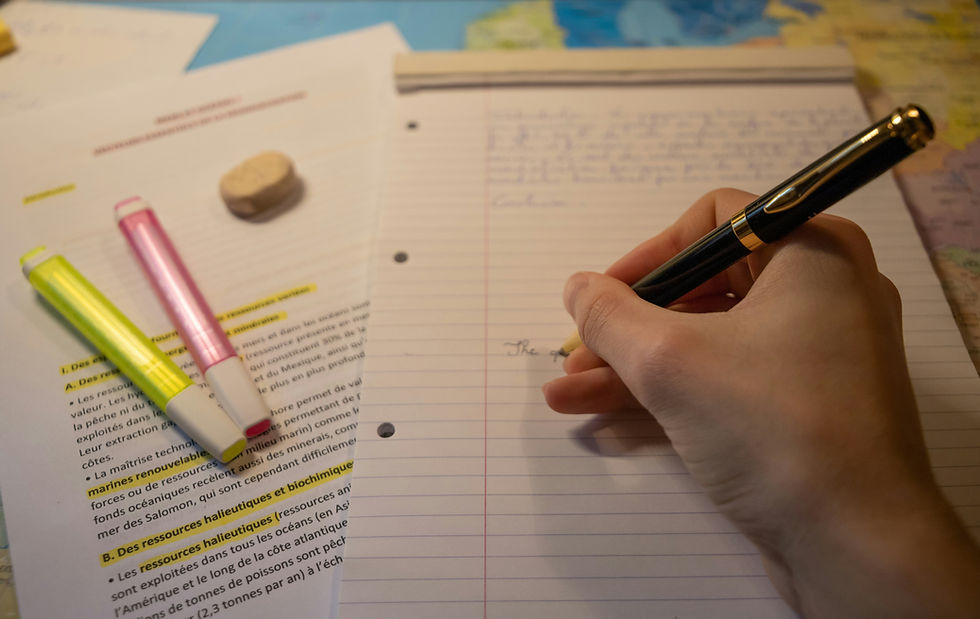
So why start with a deep-dive on the final process? This involves the most style, and is often the least thought about in personal and professional writing. Writing to communicate is the process of rejecting that tantalizing thought that your work is 'good enough' and polishing it into something truly worth reading.
When am I writing to communicate? There is no clearly defined transition point. So, we'll start with some questions that should come up in the later stages of writing to think. These are simpler questions that steer your early revisions in the right direction:
Questions while Writing to Think:
Does the body of my paper match what the introduction says it will (in content and organization)?
Will my organization be intuitive to the reader?
Would I be convinced of this argument? What am I misisng? What evidence is not tied to a conclusion, and what conclusions are unsupported by evidence. (Reverse outlines and logic diagrams are excellent tools for this.)
Does this paragraph have a clear topic sentence?
Does this paragraph have more than one major idea?
Questions while Writing to Communicate:
Does everything in this paragraph contribute to the topic sentence? If not, is it just in the wrong place? Or is it unnecessary?
Would breaking this long paragraph help the reader better understand my argument?
Do I need to provide transitions to help the reader understand connections, or to smooth out the prose? (Read aloud, have it read to you, or listen using digital tools.)
Is this sentence clear? (Ask for every... single... sentence.)
Does the introduction give the reader a clear idea of my argument and how the paper will flow?
Editing Tips:
Fact-Checking - When writing an argumentative piece that cites sources, always go back to the original sources to confirm your description of the text. It's not uncommon for a citation to lose its context and validity over multiple rounds of edits. Incorrect citations, or incorrectly citing another's work is a surefire way to lose credibility.
Copy-Editing - Your final edit that looks exclusively at typographical and grammatical errors. You need to be disciplined and avoid any other revision in this step, as you are likely to add more of those mistakes you are trying to eliminate. Working line-by-line from the final sentence to the first is an excellent technique to avoid getting wrapped back up in the argument.

Read it aloud, or have it read to you. If you find yourself slowing down or re-reading, you have identified a problem.
Look for unclear antecedents, I am the king of the vague "this/that" subject. Don't invite confusion into your paper.
Replace weak verb + adverb combinations with stronger verbs. This is one of my favorite ways to articulate this advice. Adverbs (like passive voice) are not incorrect, or inappropriate for all situations. However, you will often find that an adverb, meant to build a verb up, often weakens them both. Get out your dictionary, learn better verbs.
Replace vague or generic words and clauses with those that are more concrete.
Delete unnecessary words. Ask yourself "if I delete this word, does the meaning of this sentence change?" If not, delete it.
Break up long paragraphs (in logical places). Paragraph structure is part grammar and part style. A long paragraph is taxing on the reader's brain and can lead to them zoning out. Find ways to split up your ideas to give them a mental "breath."


Comments